


Rafael Gómez-Bombarelli recounts an almost cinematic moment in which a young PhD candidate in chemistry in Salamanca, Spain, realizes halfway through his experimental research that using a computer to simulate a chemical reaction is not only quicker than doing it in a lab. In a sense, it was more truthful. “Programming is also a lot less limited by what you can do with your hands,” he said. That intuition, which originated somewhere between a cluttered lab bench and a Spanish university, has subtly developed into one of the most ambitious materials science research initiatives in existence today.
Now a recently tenured associate professor at MIT, Gómez-Bombarelli’s work lies at the very edge of contemporary science, combining machine learning, generative AI, and physics-based simulations to find materials that, in some cases, probably couldn’t have been found in any other way. New materials for batteries, catalysts, plastics, and OLEDs have been developed thanks to his lab. The list may seem overly neat to one research team, but the fundamental approach is the same: let the machine investigate the areas of chemical space that are just out of reach for human hands.
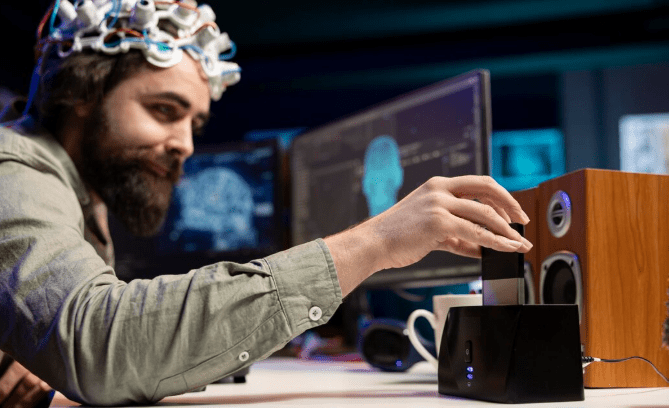
His current framing is noteworthy because it goes beyond his claims of incremental progress. This is what he refers to as a second turning point. The first introduced generative AI and representation learning to scientific research around 2015. It was a real, quantifiable wave. This new one, in his opinion, is something different—a combination of language models and physical reasoning, where AI starts to reason simultaneously across material structures, synthesis recipes, and scientific literature in addition to processing data. Although it’s still unclear if the technology can achieve that, it’s hard to ignore the early indications.
A parallel effort has been emerging throughout Cambridge. FutureHouse, which was co-founded by Sam Rodriques, an alumnus of MIT, is creating AI agents that are specifically made to read everything, synthesize it, and draw conclusions from the entire picture—tasks that working scientists seldom have time to perform. During his own PhD at MIT, Rodriques developed this obsession while researching the brain in Ed Boyden’s lab. He came to what seemed like a frustrating conclusion: the information needed to comprehend the brain might already be found somewhere in the scientific literature. No one simply had the bandwidth or time to put it together. That issue remained with him.
That realization has an almost melancholic quality, which subtly explains why FutureHouse’s mission resonates beyond the typical AI startup pitch. According to several thorough analyses, scientific productivity has been declining for decades; longer timelines, larger teams, and more funding all result in discoveries that were once made more quickly. The weight of accumulated knowledge is one of the genuinely complex reasons. Reading is not even the difficult part; there is just too much to read. It’s making sense of it.
The larger MIT community appears to be wagering that the current generation of AI, which is multimodal, language-capable, and increasingly capable of reasoning rather than just retrieving, will eventually have the necessary architecture. The goal is to break through the barrier that information overload and experimental bottlenecks have placed on the speed at which good ideas can truly advance, not to replace scientists, as is always the nervous framing. Even though the timeline is still unclear, it’s difficult not to feel that the ambition here is sincere as you watch this develop.
The truthful disclaimer is that science has previously welcomed its own revolutions with exaggerated expectations. Promises made during the initial AI boom took decades to partially materialize. However, there is now a structural difference: researchers like Gómez-Bombarelli are not working from conjecture, the data is richer, and the tools are more general. They operate based on outcomes.
