

Close Menu
CheraghchiCheraghchi
  • Home
  • Contact
  • Privacy Policy
  • Disclaimer
  • About
  • Terms of Service
  • News
  • Research
  • Trending
What's Hot

How Coding Against Synchronisation Errors — the Subject of a CMU Post-Doc’s Dissertation — Is Becoming Critical for 6G

June 3, 2026

Space-Based Computing – Why Orbiting Servers Are the Future of Global Data

June 3, 2026

Accelerating Discovery – How MIT Uses AI to Simulate the Impossible

June 3, 2026
  • All
  • Trending
  • News
  • Research
CheraghchiCheraghchi
Subscribe
  • Home
  • Contact
  • Privacy Policy
  • Disclaimer
  • About
  • Terms of Service
  • News
  • Research
  • Trending
CheraghchiCheraghchi
Home » Space-Based Computing – Why Orbiting Servers Are the Future of Global Data
News

Space-Based Computing – Why Orbiting Servers Are the Future of Global Data

Brenda RodriguezBy Brenda RodriguezJune 3, 2026No Comments4 Mins Read
Share Facebook Twitter Pinterest LinkedIn Tumblr Reddit Telegram Email
Space-Based Computing: Why Orbiting Servers Are the Future of Global Data
Share
Facebook Twitter LinkedIn Pinterest Email

Many people recently stopped mid-scrolling because of a job posting from Nvidia. Orbital data-center system architect is the title. Take your time reading that. A company that is best known for its artificial intelligence and video game chips is currently looking for someone to assist with the construction of computing infrastructure in space. More about the future of the tech sector can be found in that one job posting than in the majority of earnings calls.

Even though the engineering is complex, the backstory isn’t. At least the kind of power that data centers can swiftly, affordably, and without causing years of permitting battles is running out on Earth. AI workloads are increasing more quickly than any grid expansion could possibly keep up. Simone Larsson, Lenovo’s head of enterprise AI, stated it simply: there will come a point at which the current architecture will no longer be suitable. The foundation is cracking, to put it politely.
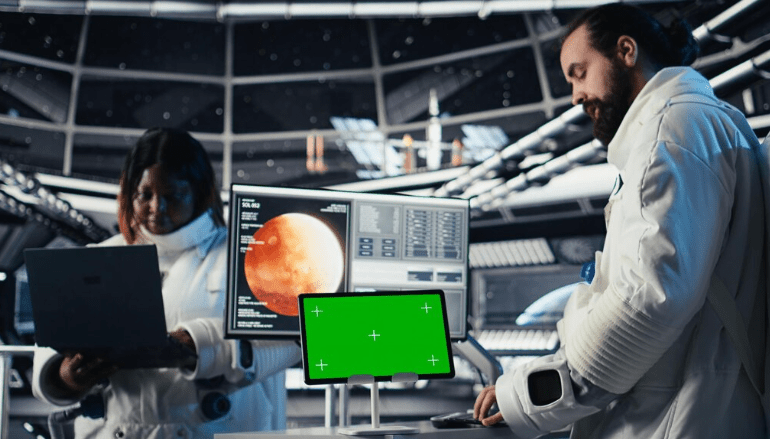
Space-Based Computing: Why Orbiting Servers Are the Future of Global Data

Y Combinator-backed startup Starcloud was one of the first to put actual hardware where the goal was. The company launched an Nvidia H100-class system into orbit on a SpaceX Falcon 9 in November 2025. They used space to train a language model. Up there, they used a version of Google Gemini. Even though it’s still early (one satellite, small scale), the fact that it happened is more important than the details at this time.

Beyond the novelty, physics is what makes space truly appealing for this. In Earth orbit, solar irradiance is roughly 36% greater than it is on Earth’s surface. Storm systems, cloud cover disruptions, property taxes, and complaints from neighbors regarding construction noise are all absent. A constellation can receive nearly constant sunlight if it is in a sun-synchronous dawn-dusk orbit. That is the entire point of contention for a server farm that consumes a lot of power.

In January 2026, SpaceX submitted plans for millions of satellites to the FCC. Blue Origin unveiled its TeraWave constellation, which consists of about 5,400 satellites designed to provide high-throughput networking for government and business customers. China unveiled a constellation of 200,000 satellites, primarily focused on state-level coordination and data sovereignty. The scale under discussion has rapidly changed from experimental to strategic, which begs the question of how and by whom any of this is governed.

However, the physics becomes problematic during cooling. Convection, or the movement of heat away from components by air or water, is used in data centers on Earth. The only available mechanism in orbit is radiation, which is far less effective. This thermal constraint may be the most persistent challenge to the entire idea, according to a recent World Economic Forum observation. Businesses are attempting to find a solution, but it hasn’t been found yet.

According to a Google feasibility study from late 2025, orbital data centers could become economically competitive with terrestrial facilities by about 2035 if Starship achieves 180 launches annually and launch costs per kilogram fall to about $200. That sentence has a lot of weight because it is conditional. “If” is working hard there. However, the fact that Google even ran those figures indicates that the discussion within big tech companies is more serious than most outsiders are aware.

It’s difficult to ignore this historical resonance. Most observers also thought that early internet infrastructure was incredibly costly and logistically disorganized. Space-based computing might be in that same awkward transitional stage, beyond the realm of pure theory but still far from practicality. There is a certain gravity to witnessing serious money, serious engineers, and serious regulatory filings all come together on the same concept at the same time. Perhaps that is the most truthful signal out there.

Orbiting Space-Based
Share. Facebook Twitter Pinterest LinkedIn Tumblr Email
Previous ArticleAccelerating Discovery – How MIT Uses AI to Simulate the Impossible
Next Article How Coding Against Synchronisation Errors — the Subject of a CMU Post-Doc’s Dissertation — Is Becoming Critical for 6G
Brenda Rodriguez
  • Website

Brenda Rodriguez is a doctoral research student in computer science at Stanford University who is passionate about mathematics and computing. She studies the intricate relationship between theory, algorithms, and applied mathematics. She regularly delves into the most recent scholarly articles with a sincere love for research literature, deconstructing difficult concepts with accuracy and clarity.Brenda covers the latest advancements in computing and mathematics research as Senior Editor at cheraghchi.info, making cutting-edge concepts accessible to inquisitive minds worldwide. Brenda finds the ideal balance between the demanding academic life and the natural world by recharging outside when she's not buried in research papers or conducting experiments, whether it's hiking trails or just taking in the fresh air.

Related Posts

News

How Coding Against Synchronisation Errors — the Subject of a CMU Post-Doc’s Dissertation — Is Becoming Critical for 6G

June 3, 2026
News

Accelerating Discovery – How MIT Uses AI to Simulate the Impossible

June 3, 2026
News

Robot Dogs from Scratch – Inside Stanford’s Wildly Popular Intro Robotics Course

June 3, 2026
Add A Comment
Leave A Reply Cancel Reply

You must be logged in to post a comment.

News

How Coding Against Synchronisation Errors — the Subject of a CMU Post-Doc’s Dissertation — Is Becoming Critical for 6G

Brenda RodriguezJune 3, 2026

A certain type of scholarly work sits silently on a university server for years, downloaded…

Space-Based Computing – Why Orbiting Servers Are the Future of Global Data

June 3, 2026

Accelerating Discovery – How MIT Uses AI to Simulate the Impossible

June 3, 2026

Robot Dogs from Scratch – Inside Stanford’s Wildly Popular Intro Robotics Course

June 3, 2026

The Obscure Mathematical Proof That Could Determine Whether AI Ever Becomes Truly Intelligent

June 3, 2026

Why America’s Best Theoretical Computer Scientists Keep Ending Up at the Same Three Universities

June 3, 2026

How the Mathematics of High-Dimensional Geometry Is Quietly Solving Problems in Drug Discovery and Genomics

June 3, 2026
Most Popular

The Traveling Tournament Problem: How Math Schedules Professional Sports

May 2, 20261 Views

How Coding Against Synchronisation Errors — the Subject of a CMU Post-Doc’s Dissertation — Is Becoming Critical for 6G

June 3, 20260 Views

Space-Based Computing – Why Orbiting Servers Are the Future of Global Data

June 3, 20260 Views
About
About

The research published here sits at the boundary of theoretical computer science, coding theory, information theory, and cryptography. The central questions driving this work are mathematical in nature: what are the fundamental limits of reliable communication over noisy channels? How much information can be protected against adversarial tampering? How can high-dimensional sparse signals be recovered from few measurements? How does randomness help — or hinder — efficient computation?
These questions matter both as deep mathematical problems and as foundations for practical systems in data storage, communications, privacy, and security.

Discalimer

This website makes research papers, preprints, and manuscripts accessible for scholarly and instructional purposes. Research findings are subject to revision, correction, and peer review even though every attempt is made to ensure accuracy. The final published versions of preprints and manuscripts may be different from those posted here. For reference and citation purposes, readers should refer to the official published versions. A paper is not endorsed by any journal, conference, or publisher just because it appears on this website.

No Expert Guidance
This website does not provide any legal, financial, investment, medical, or other professional advice. Applications in communications, cryptography, data security, and computer systems are the subject of theoretical and scholarly research discussions. They shouldn’t be used as a guide when making operational, financial, or commercial decisions. A qualified professional should be consulted by readers who need professional advice.

Disclosure of Finances
Under grants NSF CCF-2107345 and NSF CCF-2006455, the US National Science Foundation provided partial funding for research carried out and published through this website. This funding does not constitute a financial stake in any commercial product, business, or technology; rather, it solely supports academic research activities.
This website doesn’t accept sponsored content, run advertisements, or get paid for highlighting, endorsing, or linking to any goods, services, or businesses. Any external links are not endorsements or commercial relationships; they are only included for academic reference and convenience.
Any business or product that may be discussed or cited in research published on this website has no financial stake in the author and is not compensated by them. Any significant changes to this will be made publicly known.

  • Home
  • Contact
  • Privacy Policy
  • Disclaimer
  • About
  • Terms of Service
  • News
  • Research
  • Trending
© 2026 ThemeSphere. Designed by ThemeSphere.

Type above and press Enter to search. Press Esc to cancel.