

Close Menu
CheraghchiCheraghchi
  • Home
  • Contact
  • Privacy Policy
  • Disclaimer
  • About
  • Terms of Service
  • News
  • Research
  • Trending
What's Hot

Space-Based Computing – Why Orbiting Servers Are the Future of Global Data

June 3, 2026

Accelerating Discovery – How MIT Uses AI to Simulate the Impossible

June 3, 2026

Robot Dogs from Scratch – Inside Stanford’s Wildly Popular Intro Robotics Course

June 3, 2026
  • All
  • Trending
  • News
  • Research
CheraghchiCheraghchi
Subscribe
  • Home
  • Contact
  • Privacy Policy
  • Disclaimer
  • About
  • Terms of Service
  • News
  • Research
  • Trending
CheraghchiCheraghchi
Home » Accelerating Discovery – How MIT Uses AI to Simulate the Impossible
News

Accelerating Discovery – How MIT Uses AI to Simulate the Impossible

Brenda RodriguezBy Brenda RodriguezJune 3, 2026No Comments4 Mins Read
Share Facebook Twitter Pinterest LinkedIn Tumblr Reddit Telegram Email
Accelerating Discovery: How MIT Uses AI to Simulate the Impossible
Share
Facebook Twitter LinkedIn Pinterest Email

Rafael Gómez-Bombarelli recounts an almost cinematic moment in which a young PhD candidate in chemistry in Salamanca, Spain, realizes halfway through his experimental research that using a computer to simulate a chemical reaction is not only quicker than doing it in a lab. In a sense, it was more truthful. “Programming is also a lot less limited by what you can do with your hands,” he said. That intuition, which originated somewhere between a cluttered lab bench and a Spanish university, has subtly developed into one of the most ambitious materials science research initiatives in existence today.

Now a recently tenured associate professor at MIT, Gómez-Bombarelli’s work lies at the very edge of contemporary science, combining machine learning, generative AI, and physics-based simulations to find materials that, in some cases, probably couldn’t have been found in any other way. New materials for batteries, catalysts, plastics, and OLEDs have been developed thanks to his lab. The list may seem overly neat to one research team, but the fundamental approach is the same: let the machine investigate the areas of chemical space that are just out of reach for human hands.
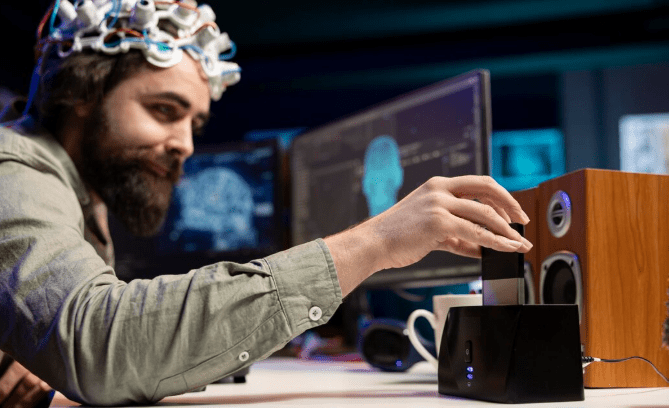
Accelerating Discovery: How MIT Uses AI to Simulate the Impossible

His current framing is noteworthy because it goes beyond his claims of incremental progress. This is what he refers to as a second turning point. The first introduced generative AI and representation learning to scientific research around 2015. It was a real, quantifiable wave. This new one, in his opinion, is something different—a combination of language models and physical reasoning, where AI starts to reason simultaneously across material structures, synthesis recipes, and scientific literature in addition to processing data. Although it’s still unclear if the technology can achieve that, it’s hard to ignore the early indications.

A parallel effort has been emerging throughout Cambridge. FutureHouse, which was co-founded by Sam Rodriques, an alumnus of MIT, is creating AI agents that are specifically made to read everything, synthesize it, and draw conclusions from the entire picture—tasks that working scientists seldom have time to perform. During his own PhD at MIT, Rodriques developed this obsession while researching the brain in Ed Boyden’s lab. He came to what seemed like a frustrating conclusion: the information needed to comprehend the brain might already be found somewhere in the scientific literature. No one simply had the bandwidth or time to put it together. That issue remained with him.

That realization has an almost melancholic quality, which subtly explains why FutureHouse’s mission resonates beyond the typical AI startup pitch. According to several thorough analyses, scientific productivity has been declining for decades; longer timelines, larger teams, and more funding all result in discoveries that were once made more quickly. The weight of accumulated knowledge is one of the genuinely complex reasons. Reading is not even the difficult part; there is just too much to read. It’s making sense of it.

The larger MIT community appears to be wagering that the current generation of AI, which is multimodal, language-capable, and increasingly capable of reasoning rather than just retrieving, will eventually have the necessary architecture. The goal is to break through the barrier that information overload and experimental bottlenecks have placed on the speed at which good ideas can truly advance, not to replace scientists, as is always the nervous framing. Even though the timeline is still unclear, it’s difficult not to feel that the ambition here is sincere as you watch this develop.

The truthful disclaimer is that science has previously welcomed its own revolutions with exaggerated expectations. Promises made during the initial AI boom took decades to partially materialize. However, there is now a structural difference: researchers like Gómez-Bombarelli are not working from conjecture, the data is richer, and the tools are more general. They operate based on outcomes.

Accelerating Simulate
Share. Facebook Twitter Pinterest LinkedIn Tumblr Email
Previous ArticleRobot Dogs from Scratch – Inside Stanford’s Wildly Popular Intro Robotics Course
Next Article Space-Based Computing – Why Orbiting Servers Are the Future of Global Data
Brenda Rodriguez
  • Website

Brenda Rodriguez is a doctoral research student in computer science at Stanford University who is passionate about mathematics and computing. She studies the intricate relationship between theory, algorithms, and applied mathematics. She regularly delves into the most recent scholarly articles with a sincere love for research literature, deconstructing difficult concepts with accuracy and clarity.Brenda covers the latest advancements in computing and mathematics research as Senior Editor at cheraghchi.info, making cutting-edge concepts accessible to inquisitive minds worldwide. Brenda finds the ideal balance between the demanding academic life and the natural world by recharging outside when she's not buried in research papers or conducting experiments, whether it's hiking trails or just taking in the fresh air.

Related Posts

News

Space-Based Computing – Why Orbiting Servers Are the Future of Global Data

June 3, 2026
News

Robot Dogs from Scratch – Inside Stanford’s Wildly Popular Intro Robotics Course

June 3, 2026
News

Why America’s Best Theoretical Computer Scientists Keep Ending Up at the Same Three Universities

June 3, 2026
Add A Comment
Leave A Reply Cancel Reply

You must be logged in to post a comment.

News

Space-Based Computing – Why Orbiting Servers Are the Future of Global Data

Brenda RodriguezJune 3, 2026

Many people recently stopped mid-scrolling because of a job posting from Nvidia. Orbital data-center system…

Accelerating Discovery – How MIT Uses AI to Simulate the Impossible

June 3, 2026

Robot Dogs from Scratch – Inside Stanford’s Wildly Popular Intro Robotics Course

June 3, 2026

The Obscure Mathematical Proof That Could Determine Whether AI Ever Becomes Truly Intelligent

June 3, 2026

Why America’s Best Theoretical Computer Scientists Keep Ending Up at the Same Three Universities

June 3, 2026

How the Mathematics of High-Dimensional Geometry Is Quietly Solving Problems in Drug Discovery and Genomics

June 3, 2026

Fish Monitoring and Computer Vision – MIT’s Surprising Leap into Citizen Science

June 3, 2026
Most Popular

The Traveling Tournament Problem: How Math Schedules Professional Sports

May 2, 20261 Views

Space-Based Computing – Why Orbiting Servers Are the Future of Global Data

June 3, 20260 Views

Accelerating Discovery – How MIT Uses AI to Simulate the Impossible

June 3, 20260 Views
About
About

The research published here sits at the boundary of theoretical computer science, coding theory, information theory, and cryptography. The central questions driving this work are mathematical in nature: what are the fundamental limits of reliable communication over noisy channels? How much information can be protected against adversarial tampering? How can high-dimensional sparse signals be recovered from few measurements? How does randomness help — or hinder — efficient computation?
These questions matter both as deep mathematical problems and as foundations for practical systems in data storage, communications, privacy, and security.

Discalimer

This website makes research papers, preprints, and manuscripts accessible for scholarly and instructional purposes. Research findings are subject to revision, correction, and peer review even though every attempt is made to ensure accuracy. The final published versions of preprints and manuscripts may be different from those posted here. For reference and citation purposes, readers should refer to the official published versions. A paper is not endorsed by any journal, conference, or publisher just because it appears on this website.

No Expert Guidance
This website does not provide any legal, financial, investment, medical, or other professional advice. Applications in communications, cryptography, data security, and computer systems are the subject of theoretical and scholarly research discussions. They shouldn’t be used as a guide when making operational, financial, or commercial decisions. A qualified professional should be consulted by readers who need professional advice.

Disclosure of Finances
Under grants NSF CCF-2107345 and NSF CCF-2006455, the US National Science Foundation provided partial funding for research carried out and published through this website. This funding does not constitute a financial stake in any commercial product, business, or technology; rather, it solely supports academic research activities.
This website doesn’t accept sponsored content, run advertisements, or get paid for highlighting, endorsing, or linking to any goods, services, or businesses. Any external links are not endorsements or commercial relationships; they are only included for academic reference and convenience.
Any business or product that may be discussed or cited in research published on this website has no financial stake in the author and is not compensated by them. Any significant changes to this will be made publicly known.

  • Home
  • Contact
  • Privacy Policy
  • Disclaimer
  • About
  • Terms of Service
  • News
  • Research
  • Trending
© 2026 ThemeSphere. Designed by ThemeSphere.

Type above and press Enter to search. Press Esc to cancel.